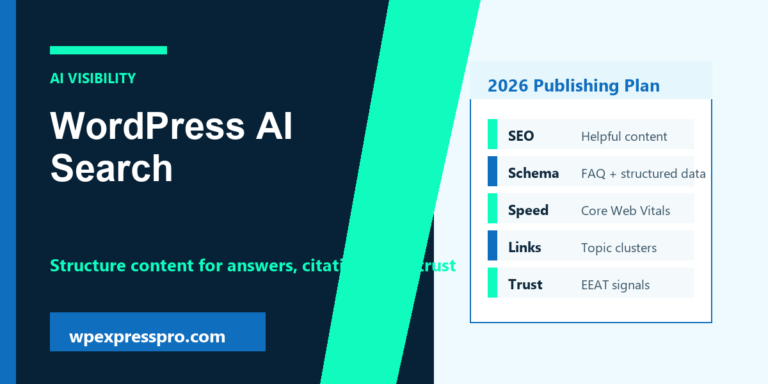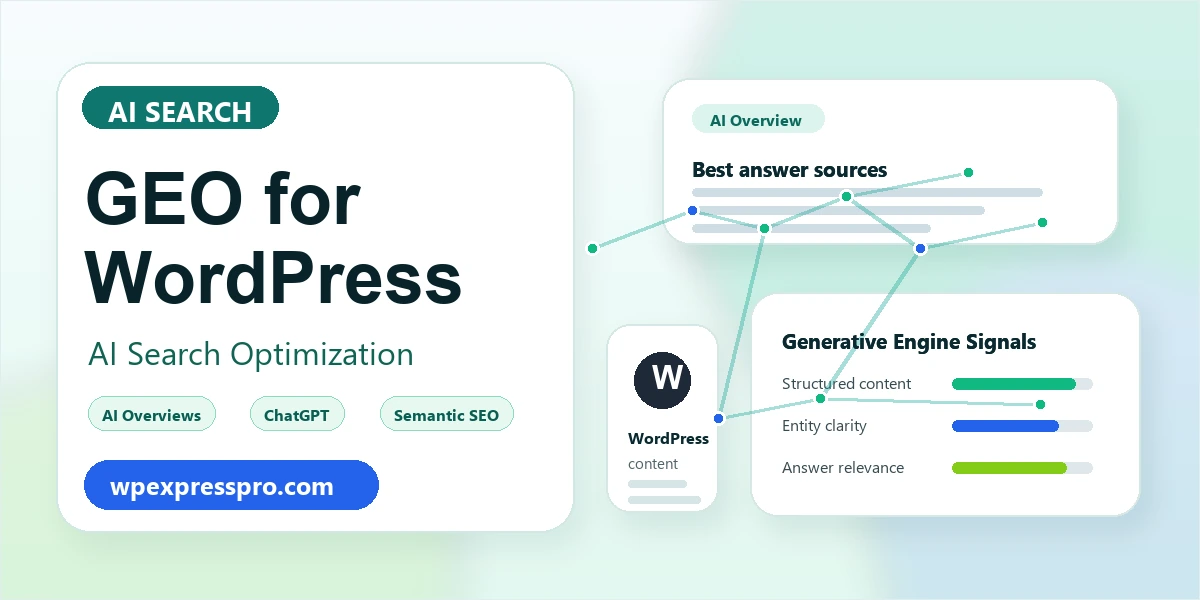
Search is changing fast. People still use Google, but more answers now come from AI Overviews, ChatGPT, Perplexity, Gemini and other answer engines. That is why GEO for WordPress is becoming a practical topic for site owners who already care about SEO but want their content to be visible in AI-generated answers too.
GEO stands for Generative Engine Optimization. The goal is not to trick AI systems. The goal is to make your WordPress content easier to understand, verify, summarize and cite. That means clear structure, trustworthy information, schema, useful answers, internal context and human proof.
This guide explains how GEO fits into WordPress SEO, how it differs from traditional SEO and AEO, and how to prepare your pages for AI search without turning your website into robotic content.
Table of Contents
What Is GEO for WordPress?
GEO for WordPress is the process of optimizing WordPress content so generative search systems can understand and cite it. Traditional SEO is still important, but AI search systems do not always behave like a classic list of blue links. They synthesize answers, compare sources and may cite pages differently from normal organic rankings.
A recent measurement study of Google AI Overviews found that cited domains can differ from ordinary first-page results, and that question-style queries activate AI answers much more often. That means WordPress sites need to think beyond keyword placement. They need pages that answer complete questions, demonstrate trust and provide extractable sections.
In simple terms, GEO asks: if an AI system reads this page, will it quickly understand what the page is about, why it should trust it and which answer it can safely quote?
GEO vs SEO vs AEO
SEO, AEO and GEO overlap, but they are not identical. SEO improves visibility in search engines. AEO, or Answer Engine Optimization, focuses on concise answers for featured snippets, voice search and answer boxes. GEO focuses on visibility inside generative AI answers, where the system may synthesize information from multiple sources.
| Method | Main goal | WordPress focus |
|---|---|---|
| SEO | Rank and earn clicks in search results. | Technical SEO, content quality, internal links, metadata, speed and authority. |
| AEO | Answer direct questions clearly. | FAQ sections, concise definitions, how-to steps and schema. |
| GEO | Be understood and cited by AI answer engines. | Structured content, trusted sources, author signals, entity clarity and crawlable pages. |
The best WordPress strategy combines all three. You still need crawlable pages, useful content and strong site architecture. GEO simply adds another layer: make the content easy for machines to interpret without making it worse for humans.
Why AI Search Changes WordPress Content Strategy
AI search changes the reward system. A user may get an answer without clicking a website. They may see a short summary with citations, then ask follow-up questions in the same search experience. That means visibility can come from being cited, summarized or used as a source, not only from holding a normal ranking position.
WordPress VIP?s CTO recently described the future as serving both human and agent audiences. That is a useful way to think about GEO. Your content should still be written for people, but it should also be organized so AI systems can parse sections, definitions, facts, author context and relationships between topics.
For WordPress sites, this makes content architecture more important. Thin posts, vague headings and generic AI-generated pages are easy to ignore. Clear topic hubs, updated guides, original examples and consistent internal links are easier for both humans and machines to trust.
How to Structure WordPress Content for AI Answers
The first GEO improvement is structure. AI systems work better when a page has clear sections, direct answers and enough supporting context. You do not need to write only in FAQ format, but you should make important answers easy to locate.
- Use one clear H1 and descriptive H2/H3 headings.
- Answer the main question near the beginning of the page.
- Add short definitions before deeper explanations.
- Use comparison tables for tools, methods, prices or pros and cons.
- Use bullet lists for steps, checklists and criteria.
- Add examples from real WordPress workflows, not only generic advice.
- Link to related posts so the site shows topical depth.
A strong GEO page should feel helpful to a human reader and easy to segment for an AI system. If a paragraph contains three separate ideas, split it. If a section has no clear point, rewrite the heading. If a claim needs support, cite a source or add evidence.
Schema, FAQ and Rank Math
Schema does not guarantee AI citations, but it helps define what a page is about. Rank Math can help WordPress users add Article schema, breadcrumbs, FAQ blocks and other structured data without editing JSON-LD manually.
FAQ schema is still useful when the questions are genuinely helpful and visible on the page. Even though Google removed broad FAQ rich result support in 2026, FAQ content can still make answers clearer for readers and easier for systems to interpret. The key is not adding FAQs for decoration. Use them to answer real decision questions.
Rank Math also helps with SEO titles, meta descriptions, canonical settings, redirects and content checks. For GEO, the important habit is consistency: one clear topic per page, accurate metadata, useful schema and internal links that connect related topics.
Trust Signals That AI Systems Can Understand
AI systems need signals that a page is reliable. Some of those signals are technical, but many are editorial. A WordPress page should make it obvious who wrote it, when it was updated, what evidence supports it and why the site has authority on the topic.
- Add author bios with relevant experience.
- Keep publication and updated dates visible where appropriate.
- Cite primary sources, documentation and credible research.
- Include original screenshots, examples, tests or process notes.
- Avoid unsupported claims such as ?best? without criteria.
- Build topic clusters instead of isolated one-off posts.
- Use consistent business details, contact information and About pages.
GEO is not only a formatting exercise. If AI systems favor trusted sources, your site needs actual trust. That comes from accuracy, consistency and evidence, not from stuffing keywords into headings.
Technical SEO for AI Search
AI search still depends on accessible web content. If crawlers cannot access your pages, if the content is hidden behind scripts, or if the site is slow and messy, AI visibility becomes harder.
- Make important content visible in the HTML, not only loaded through fragile scripts.
- Keep XML sitemaps clean and submitted.
- Use internal links so crawlers can discover related pages.
- Optimize Core Web Vitals and mobile usability.
- Use descriptive image alt text and compressed WebP images.
- Avoid accidental noindex tags on important content.
- Review robots.txt and crawler settings before blocking AI-related crawlers.
There is no universal crawler policy that fits every business. Some publishers may choose to restrict AI crawling. Others may want maximum discoverability. The key is making that choice deliberately instead of leaving it to chance.
Common GEO Mistakes to Avoid
The biggest mistake is treating GEO as a shortcut. AI search is not looking for more generic AI-written content. It needs reliable sources, clear explanations and pages that can support claims.
- Publishing many thin AI posts without experience or proof.
- Using vague headings that hide the real answer.
- Adding FAQ sections that repeat the same generic questions on every page.
- Ignoring author, update and source credibility signals.
- Optimizing only for Google while ignoring ChatGPT, Perplexity, Gemini and other answer engines.
- Blocking important pages from crawlers without understanding the visibility tradeoff.
- Forgetting conversion paths because users may arrive after reading an AI summary.
The best GEO work usually improves normal SEO too. Clear answers, useful sections, schema, internal links and trust signals all help people understand the page. That is the sweet spot: content that serves readers and machines at the same time.
FAQ: GEO for WordPress
What does GEO mean in WordPress SEO?
GEO usually means Generative Engine Optimization: making your WordPress content easier for AI search systems and answer engines to understand, trust, summarize and cite.
Does GEO replace traditional SEO?
No. GEO builds on SEO. Fast pages, crawlable content, clear headings, internal links, schema and useful information still matter. GEO adds more focus on answer clarity, source credibility and machine-readable structure.
Can Rank Math help with GEO?
Yes. Rank Math can help with titles, descriptions, schema, breadcrumbs, FAQ blocks, redirects and content checks. It does not guarantee AI citations, but it supports the structured foundation AI systems need.
How do I get my WordPress site cited in AI Overviews?
There is no guaranteed method. Improve your odds by answering specific questions clearly, using trustworthy sources, adding structured data, building topical authority, keeping content updated and making pages easy to crawl.
Final Takeaway
GEO for WordPress is not a replacement for SEO. It is the next layer of search visibility. As AI Overviews and answer engines become more common, WordPress sites need content that is structured, trustworthy, current and easy to cite.
Start with the basics: clean headings, strong answers, schema, internal links, author signals, updated content and original examples. Use Rank Math to support the technical workflow, but keep humans responsible for accuracy and expertise. That is how WordPress sites can stay useful in both classic search and AI search.
Sources checked: TechRadar interview with WordPress VIP CTO on GEO and AI search, Measuring Google AI Overviews research, How Generative AI Disrupts Search research and Rank Math FAQ Schema Block documentation.